
You’ve sorted your visa, packed your bag down to 10 kilos, and figured out how to stay connected on the road. But here’s the thing most digital nomad guides skip over: the card in your wallet can either quietly drain your travel budget — or quietly fund it.
Foreign transaction fees. Bad exchange rates. Points that expire before you redeem them. Sound familiar? The wrong credit card costs the average traveler hundreds of dollars a year without them ever noticing. The right one, on the other hand, gets you free flights, lounge access, hotel upgrades, and travel insurance — essentially getting paid to do what you’re already doing.
This guide breaks down the best travel credit cards for digital nomads in 2026, what to look for, what to avoid, and how to make every swipe work harder while you’re living and working abroad.
Why Digital Nomads Need a Dedicated Travel Credit Card
Most standard bank cards weren’t built for the way nomads live. They charge 1.5–3% on every foreign purchase, convert currency at rates that benefit the bank, and offer zero protection when something goes sideways in a country where your home bank’s helpline closes at 5pm.
A proper travel credit card fixes all of that and goes further. Here’s what separates a nomad-ready card from everything else:
-
- No foreign transaction fees — the single most important feature for anyone spending across multiple currencies.
-
- Global ATM fee waivers — critical for destinations that are still heavily cash-based.
-
- Travel rewards and points — earn miles or points on every purchase, redeemable for flights, hotels, and travel credits.
-
- Built-in travel insurance — trip cancellation, medical evacuation, and lost luggage coverage that most nomads don’t know they already have.
-
- 24/7 global customer support — because your card gets declined at 11pm in Chiang Mai, not during business hours.
-
- Metal card durability — not a dealbreaker, but a heavy card is a card ATMs won’t eat.
Stay connected wherever your travels take you — explore ConnectPls eSIM and portable WiFi plans at connectpls.com
The Best Travel Credit Cards for Digital Nomads in 2026
There’s no single ‘best’ card for every nomad — your ideal choice depends on your home country, annual spend, and whether you prioritise flights, hotels, or pure cash-back flexibility. Here are the top-performing cards that consistently make life easier for remote workers abroad.
1. Chase Sapphire Preferred (US-based nomads)
The Sapphire Preferred is still one of the most recommended starting cards for US-based digital nomads, and for good reason. It earns 3x points on dining and 2x on travel, has no foreign transaction fees, and comes with solid travel protections including trip delay insurance and primary car rental coverage.
Points transfer to over a dozen airline and hotel partners — Air Canada, British Airways, Singapore Airlines, Hyatt, and more — which means you can squeeze serious value out of a domestic card while living internationally. The annual fee sits at $95, which most nomads recover within two or three months of regular spending.
2. Amex Platinum (Premium perks, global lounge access)
If you’re spending long stretches in airports — which every nomad does more than they’d like — the Amex Platinum earns its $695 annual fee through lounge access alone. Centurion Lounges, Priority Pass, Delta SkyClubs, and Escape lounges are all included. That’s free food, fast WiFi, and somewhere quiet to work between connections.
The card also offers up to $200 in annual airline fee credits, $200 in hotel credits, and robust travel insurance. It earns 5x Membership Rewards points on flights booked directly with airlines — one of the highest rates in the market.
3. Capital One Venture X (Best all-around value)
For nomads who don’t want to play the points transfer game, the Venture X keeps it refreshingly simple. Every purchase earns 2x miles, travel earns 5x, and the $395 annual fee is offset by a $300 annual travel credit and 10,000 bonus miles every account anniversary.
Access to Capital One airport lounges and a Priority Pass membership sweeten the deal further. No foreign transaction fees. No confusing redemption rules. It’s the card you hand over without thinking about it.
4. Revolut Metal / Premium (Europe & worldwide)
Revolut isn’t technically a credit card in the traditional sense, but for European and UK-based nomads, it’s become the default spending tool. The Metal and Premium tiers offer interbank exchange rates on the weekdays (real rates, not bank markup), free ATM withdrawals up to a monthly limit, and a stock of virtual card numbers for secure online purchases.
Revolut’s budgeting tools are also genuinely useful for nomads tracking expenses across currencies, and the app shows you exactly what you spent and where — broken down by country.
5. Wise Debit Card (Multi-currency accounts)
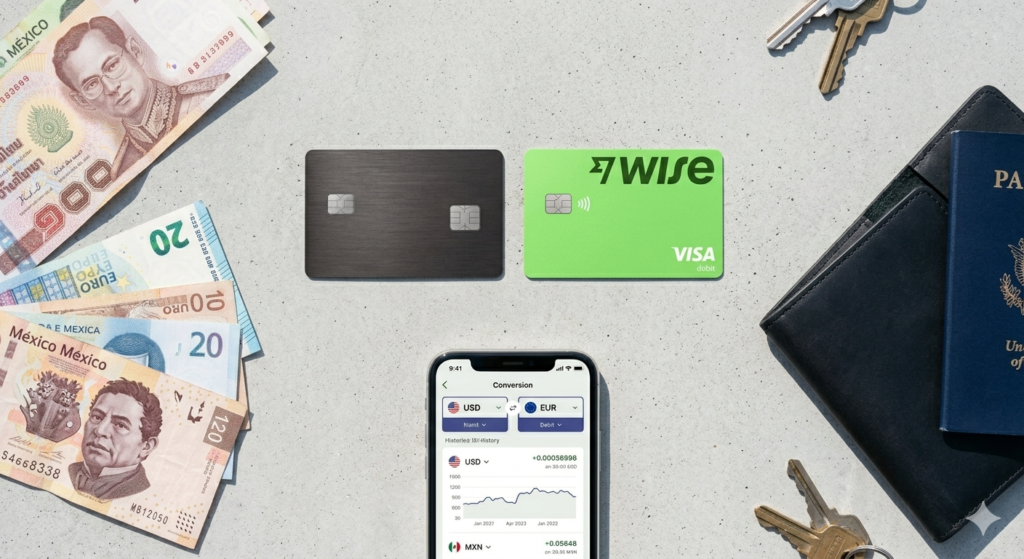
Wise (formerly TransferWise) doesn’t offer rewards, but it’s the most honest card on this list. You hold real balances in 50+ currencies, spend at the mid-market exchange rate, and pay a small, transparent conversion fee when you actually need to switch currencies. No monthly fees for the basic card, no surprise charges.
For nomads who are tired of wondering what rate they actually got, Wise is the clarity card. Many experienced nomads carry both a rewards card and a Wise card — the former for points, the latter for honest ATM withdrawals.
Reliable internet is the other half of the nomad equation — get unlimited data SIMs and eSIMs at connectpls.com/unlimited-data-sim

What to Look For (and What to Avoid)
The card market is full of shiny sign-up bonuses and fine print. Here’s a practical checklist for nomads evaluating any card:
Must-haves
-
- No foreign transaction fees — non-negotiable
-
- Broad acceptance (Visa or Mastercard over Amex for developing markets)
-
- At least 1.5x points or miles on general purchases
-
- Travel insurance that covers medical emergencies, not just delays
-
- Ability to freeze/unfreeze the card instantly via app
Red flags
-
- Dynamic currency conversion (always pay in local currency)
-
- Points that only redeem through a closed portal
-
- Annual fee not offset by clear, usable credits
-
- No global emergency replacement policy
How to Maximise Travel Points as a Digital Nomad
Earning points is one thing. Milking them is another. Here’s how nomads who’ve been at it for years get the most out of their cards:
Put all business expenses on one card. Subscriptions, software, coworking fees, equipment — these costs add up fast and most nomads pay them across multiple cards or accounts. Consolidate onto your primary rewards card.
Use category bonuses strategically. If your card earns 3x on dining, use it at every restaurant. If another earns 5x on flights, use it for all flight purchases. Multi-card strategies multiply returns significantly.
Transfer points before booking, not after. Transfer ratios between card points and airline miles are usually 1:1, but some partner programs offer seasonal transfer bonuses of up to 30%. Timing matters.
Book through the card’s travel portal when the math works. Sometimes booking through Chase Travel or Amex Travel earns more points than booking direct. Run the numbers each time.
Never let points expire. Some programs zero out your balance after 12–18 months of inactivity. Set a calendar reminder to make one small redemption or earn at least one point every year.
Travel Credit Cards and Taxes: What Nomads Should Know
A quick but important note: in most jurisdictions, points and miles earned through personal credit card spending are not considered taxable income (they’re treated as a rebate on purchases). However, sign-up bonuses tied to spending thresholds can sometimes be considered taxable, depending on where you’re tax-resident.
If you run a business through a business card, the rules shift further — especially if you’re working across borders. As always, a nomad-friendly accountant who understands territorial taxation is worth far more than the annual fee on any credit card.

Frequently Asked Questions
What is the best credit card for international travel with no foreign transaction fees?
The most consistently recommended options are the Chase Sapphire Preferred, Capital One Venture X, and Charles Schwab Investor Checking (for ATM use). All three eliminate foreign transaction fees and offer additional travel perks. For European nomads, Revolut Metal and Wise are the most practical alternatives.
Can I use my credit card in every country as a digital nomad?
Visa and Mastercard are accepted in almost every country in the world. American Express has a smaller acceptance network, which can be an issue in Southeast Asia, parts of Africa, and smaller cities globally. Always carry a backup Visa or Mastercard alongside any Amex.
Is it safe to use a credit card while travelling abroad?
Yes, and in many ways it’s safer than cash. Credit cards offer chargeback rights, fraud protection, and zero-liability policies that debit cards often lack. The key habits: use chip-and-PIN over swipe wherever possible, never allow dynamic currency conversion, and enable instant transaction notifications so you catch any suspicious activity immediately.
Do travel credit cards offer travel insurance?
Many do, but the coverage varies significantly. Premium cards like Amex Platinum and Chase Sapphire Reserve offer comprehensive protection including emergency medical evacuation, which can be worth tens of thousands of dollars. Mid-tier cards like the Sapphire Preferred cover trip delays and cancellations. Always read the certificate of insurance before relying on card coverage — some exclusions, like pre-existing conditions or certain adventure sports, can leave gaps for nomads.
How many travel credit cards should a digital nomad have?
Most experienced nomads settle on a two-card setup: one premium rewards card for earning points on travel and dining, and one transparent fee-free card (like Wise or Schwab) for ATM withdrawals and cash-based transactions. Three cards becomes manageable if you’re maximising category bonuses across multiple programs. More than three is diminishing returns for most people.
What should I do if my credit card is lost or stolen abroad?
Call the number on the back of the card immediately (most issuers have 24/7 global lines), freeze the card via the app while you’re on hold, and request an emergency card replacement. Most major issuers can get a replacement to you within 1–2 business days almost anywhere in the world. This is one reason why carrying two cards from different networks matters — if one is lost, you’re not stranded.
Are travel credit card rewards worth the annual fee?
For most active nomads, yes. A $95 annual fee card is typically recovered in the first month of travel through points on accommodation and flights alone. Premium cards with $400–$700 fees require more intentional use — but lounge access, travel credits, and insurance coverage add up quickly if you’re flying frequently. The break-even point for most premium cards is around 4–6 flights per year.
One more thing every nomad needs: reliable mobile internet in 100+ countries. Explore ConnectPls eSIM plans — no contracts, no roaming surprises: connectpls.com/esim
The Bottom Line
The best travel credit card for a digital nomad isn’t the flashiest one — it’s the one that fits how you actually live and spend. If you’re based in the US and fly frequently, the Chase Sapphire Preferred or Venture X will quietly fund parts of your travel. If you’re European or want complete currency transparency, Revolut and Wise are the backbone of smart nomad finance.
Start with one no-annual-fee option to learn the ropes, then upgrade once you understand your spend patterns. Layer in a Wise card for honest ATM access. And never, ever pay a foreign transaction fee again.
Your bank account will thank you before your next boarding pass does.