
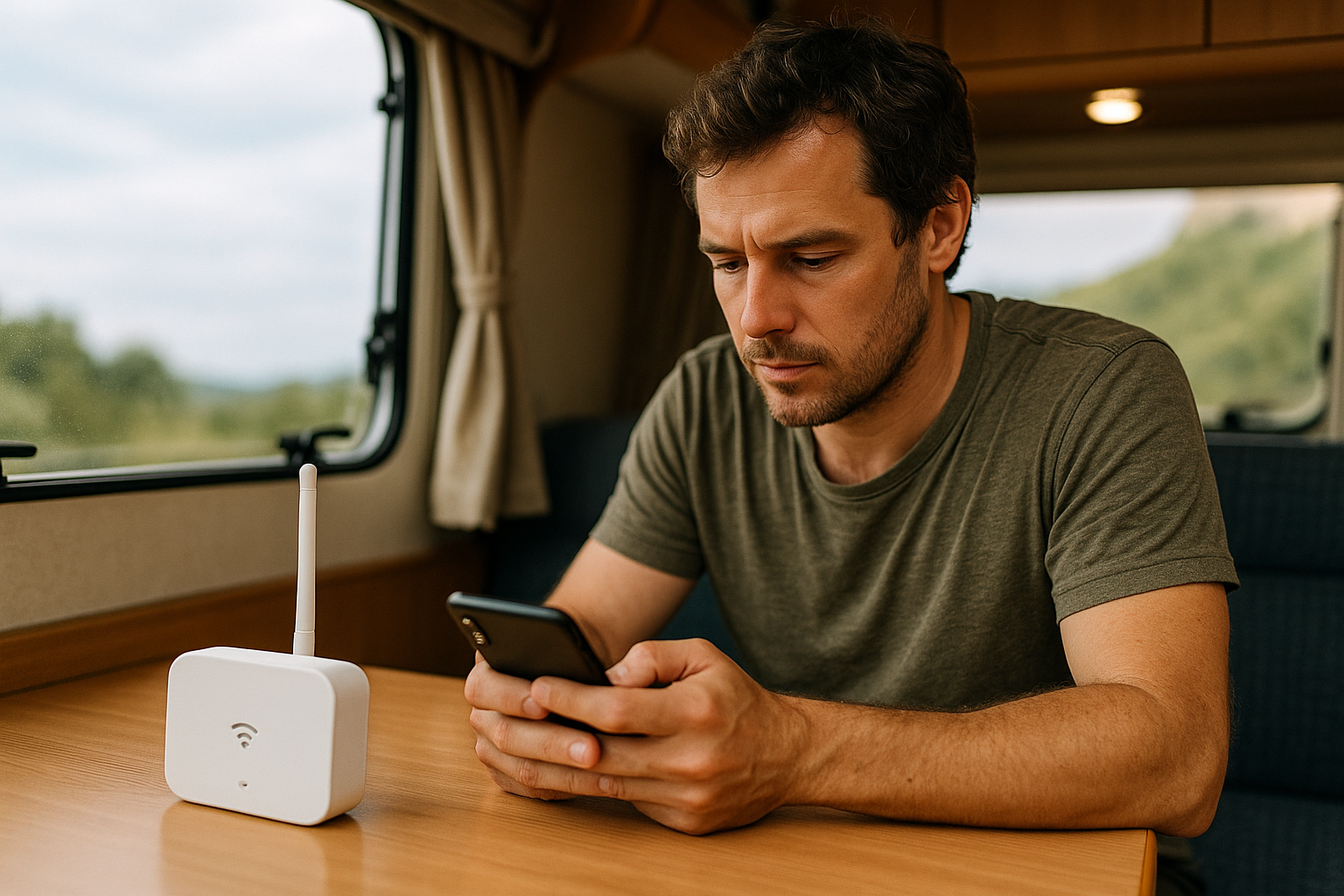
You’ve spent months planning your Europe van trip. You’ve sorted the campervan hire or bought your conversion. You’ve mapped your route from Portugal through Spain, into France, maybe up to the Netherlands or across to Italy. Then someone asks: “How will you work on the road?” and you realize you haven’t sorted connectivity.
If you’re living and working from a campervan for weeks or months at a time, your internet needs are different from a weekend tourist. You’re running video calls from a French campsite. You’re uploading client work from a Spanish beach car park. Your partner is streaming a course while you’re coding. One phone’s hotspot won’t cut it, and buying a new local SIM every time you cross a border gets old fast.
This is where a campervan 4G router with unlimited data actually earns its place. Not for everyone, but for van lifers crossing multiple countries on open-ended trips, it’s the setup that just works.
Why Van Lifers Need More Than a Phone Hotspot
Most van lifers we work with try the phone hotspot route first. It lasts about a week before the limitations hit:
- Your phone battery drains by lunchtime
- You can’t take calls while hotspotting (or the connection drops)
- Connecting a laptop, tablet, and partner’s phone simultaneously hammers your data allowance
- Roaming caps kick in after 10-15GB in most European countries, even with “unlimited” home plans
A dedicated portable WiFi router solves all of this. It connects up to 10 devices at once, runs its own battery (typically 8-12 hours), and works across borders without swapping SIMs or hunting for local shops every few weeks.
“I used their service in my campervan in Europe over a 7 week period, working remotely 3 days a week. I actually had both Starlink and their service — I used ConnectPls 99% of the time. Super reliable, with generally great speeds.”
— Peter Allen, verified ConnectPls customer
The Campervan Connectivity Comparison
Here’s how the main options stack up for van lifers doing extended Europe trips:
| Option | Best For | Drawback for Van Lifers | Multi-Device Support |
|---|---|---|---|
| Home carrier roaming | Short trips (1-2 weeks) | Roaming fair-use caps (often 10-25GB/month), expensive overages, single device unless hotspotting | Poor (drains phone battery) |
| Local SIM each country | Staying 2+ months in one country | Paperwork/ID required in some countries, new setup every border, single device, wasteful if moving frequently | Poor (one phone only) |
| eSIM plans | Solo travelers, phone/tablet only | Device-specific (can’t share easily), often expensive for high data volumes, managing multiple eSIMs across countries | Fair (one device per eSIM) |
| Portable WiFi router (monthly subscription) | Multi-country trips, 2+ people, laptops/tablets, 1-6 month journeys | Monthly cost even if you pause for a week (though flexible subscriptions help), need to carry/charge another device | Excellent (up to 10 devices) |
What “Unlimited” Actually Means Across Europe
This is where most van lifers get stung. “Unlimited” portable WiFi often means one of three things:
- Fair-use throttling: Unlimited data but slowed to unusable speeds after 10-20GB
- Country-specific caps: Unlimited in one country, but 1-2GB daily limits when roaming
- Genuinely unlimited in designated countries: No throttling, no daily caps, works the same whether you’re in Spain or Sweden
ConnectPls uses the third model for what we call Group 0 countries (around 70 destinations including all the core European van life routes: UK, Ireland, France, Germany, Spain, Portugal, Italy, Netherlands, Belgium, Austria, Switzerland, the Nordics, Poland, Czech Republic, and beyond). When we say unlimited across these countries, we mean it. No fair-use policy, no throttling after 20GB. We’ve had customers upload 200GB+ in a month from a French campsite without issues.
This matters when you’re working full-time from the road. Video calls, cloud backups, streaming for downtime: it adds up fast. The campervan parked next to you with a “pocket WiFi rental” for €8/day might discover their connection slows to 256kbps after the first 5GB.
Monthly Plans vs Daily Rentals: What Makes Sense for Van Trips
Short answer: if your trip is longer than two weeks, daily rental costs spiral.
Pocket WiFi rental companies typically charge €6-12 per day. That’s €180-360 per month, often with daily data caps (3-5GB is common), plus you’re paying for every single day including the ones you’re parked at a campsite with WiFi and don’t need it.
Monthly subscriptions for motorhome broadband work differently. You’re paying for a month at a time, pause or cancel when you’re done. ConnectPls ships the mobile router device included in the plan (you’re not buying hardware upfront), and you return it when you’re finished. Delivery takes 2-3 working days across Europe, 4-5 in the UK, so you can have it shipped to your departure point or first campsite.
For a three-month Portugal-to-Norway van trip, you’re looking at three monthly payments instead of 90 daily rental charges. And because there’s no long-term contract, you can cancel after month two if you decide to cut the trip short or pause for a month if you’re staying put with good campsite WiFi.
The Device-Included Model
This is worth highlighting because it’s different from buying a router and then hunting for a data SIM. With a subscription model, the 4G router is part of the package. It arrives at your door already set up, and you return it when you cancel (there’s a £25 fee if you cancel a mobile router subscription within the first three months, which covers the shipping and return logistics, but nothing after that).
The device connects up to 10 devices, uses Cloud SIM technology to switch between multiple operators automatically depending on signal strength, and has a backup physical SIM slot. Better coverage in rural French valleys or remote Spanish coastal spots where a single-network SIM might struggle.
Real Van Lifer Scenarios Where This Setup Wins
From supporting hundreds of van life customers, here’s where a campervan 4G router with unlimited data proves its value:
- Couples working remotely: Both need solid connections simultaneously for video calls, often from different time zones or clients
- Content creators: Uploading video files from the road (GoPro footage, YouTube content, Reels). This destroys daily data caps
- Freelancers on multi-country loops: You’re crossing 5-8 countries in three months and can’t be bothered with local SIM admin every other week
- Families homeschooling on the road: Kids streaming lessons, parents working, tablets for downtime. Easily 4-5 devices connected at once
One customer ran a three-month campervan trip through France and Spain, working as a graphic designer while his partner taught online English classes. They were pulling 60-80GB some weeks between video calls, file uploads, and evening Netflix. A single phone hotspot or a 5GB daily rental wouldn’t have lasted past week one.
What About Cheaper Options for Shorter Trips?
Honest answer: if you’re doing a two-week summer holiday in France only, a local French SIM with 50GB for €20 probably makes more sense. Same if you’re parking the van for two months in one Spanish town. Grab a Vodafone Spain SIM and you’re sorted.
But if you’re moving every few days, crossing borders regularly, or planning 1-6 months on the road, the admin overhead and border-crossing hassles of local SIMs outweigh the cost savings. And if you’re two people needing simultaneous connections for work, you’d need two local SIMs anyway. At that point a shared portable WiFi router is simpler and often cheaper.
Coverage Beyond Europe: Australia, New Zealand, North America
Not every van lifer sticks to Europe. If you’re planning a campervan trip across Australia or a motorhome loop through Canada and the US, Group 0 unlimited coverage extends to Australia, New Zealand, Canada, Mexico, and Turkey as well.
For Australia specifically (where domestic data is notoriously expensive and coverage patchy outside cities), having a portable WiFi device that switches between Telstra, Optus, and Vodafone networks automatically via Cloud SIM gives you better odds of a signal on the coastal routes.
Frequently Asked Questions
Can I use a campervan 4G router while driving?
Yes, the device works while moving. Passengers can stay connected, upload photos, or stream music as you drive. Connection quality depends on network coverage along your route. Expect drops in remote mountain passes or deep valleys, same as your phone. The Cloud SIM setup helps by switching to the strongest available network automatically.
What happens if I’m getting poor signal at a campsite?
Mount the router near a window or higher up in the van if possible. Signal improves with line of sight to the nearest tower. If the automatic Cloud SIM network isn’t performing well, you can use the backup physical SIM slot to manually select a stronger local carrier. Some van lifers also pack a small external antenna for particularly remote spots, though that’s overkill for most European campsite trips.
Do I need to return the router if I’m doing back-to-back trips?
No. If you’re pausing for a month or two between trips, you can cancel the subscription and reactivate when you’re ready to go again. Or just keep it active if you’ll use it at home between journeys. The monthly billing is flexible; you’re only paying for the months you choose to keep the service running. There’s no penalty for pausing and restarting, unlike annual contracts.
Stay connected from the moment you land
ConnectPls provides eSIM plans, SIM cards, and portable WiFi subscriptions for van lifers across 200+ countries — activated before you fly, working the moment you land, at local rates with flexible monthly billing and no surprise bills.