
When you’re living or traveling in a caravan, WiFi isn’t a luxury — it’s essential infrastructure. Whether you’re parked in the French Alps waiting for a video call to load, navigating backroads through Portugal, or streaming a series in a German campsite, your connectivity setup determines whether van life feels liberating or frustrating.
After shipping hundreds of mobile routers to people living the caravan life across Europe, we’ve seen what works (and what doesn’t) when you’re constantly crossing borders, parking in rural areas, and sharing a connection across laptops, phones, and streaming devices. This guide covers everything you need to choose the right WiFi solution for how you actually travel.
What Makes Caravan WiFi Different From Regular Travel Connectivity
The challenge with motorhome connectivity isn’t just getting online — it’s staying online across multiple countries without swapping SIM cards at every border or dealing with surprise roaming bills. You’re also typically connecting several devices at once: navigation tablets, work laptops, phones for both people in the van, sometimes a streaming device or smart camera system.
Local SIM cards work brilliantly if you’re spending a month in Spain. They fall apart when you cross into France for a long weekend, then into Italy, then back to Spain. eSIMs solve the device problem but don’t help when you need to connect a laptop, tablet, and your partner’s phone simultaneously. Home-carrier roaming is convenient until you see the bill.
That’s where dedicated caravan WiFi routers come in, but not all portable WiFi solutions are built the same.
“I’m a vanlifer and was totally let down by another company while over in Spain. These guys stepped up and gave me the greatest experience — communication was non-stop, service was impeccable.”
— Gavin Baines, verified ConnectPls customer
The Four Main Options for Motorhome Internet (And When Each Makes Sense)
| Solution | Best For | Real-World Limitation |
|---|---|---|
| Home-carrier roaming | Short trips (1-2 weeks) within your home region | Expensive beyond included allowances; single-device tethering drains battery fast |
| Local SIM cards | Staying primarily in one country for weeks/months | Requires swapping at borders; tethering often limited or banned in terms; admin overhead in each country |
| eSIM plans | Solo travelers with one primary device; backup connectivity | Can’t share connection easily; device must be eSIM-compatible; managing multiple regional eSIMs gets messy |
| Portable WiFi router (subscription) | Multi-country van life; couples/families; remote workers needing reliable uptime | Monthly cost even when not traveling (though flexible plans let you pause); overkill for short annual holidays |
How Portable WiFi Routers Actually Work in a Caravan
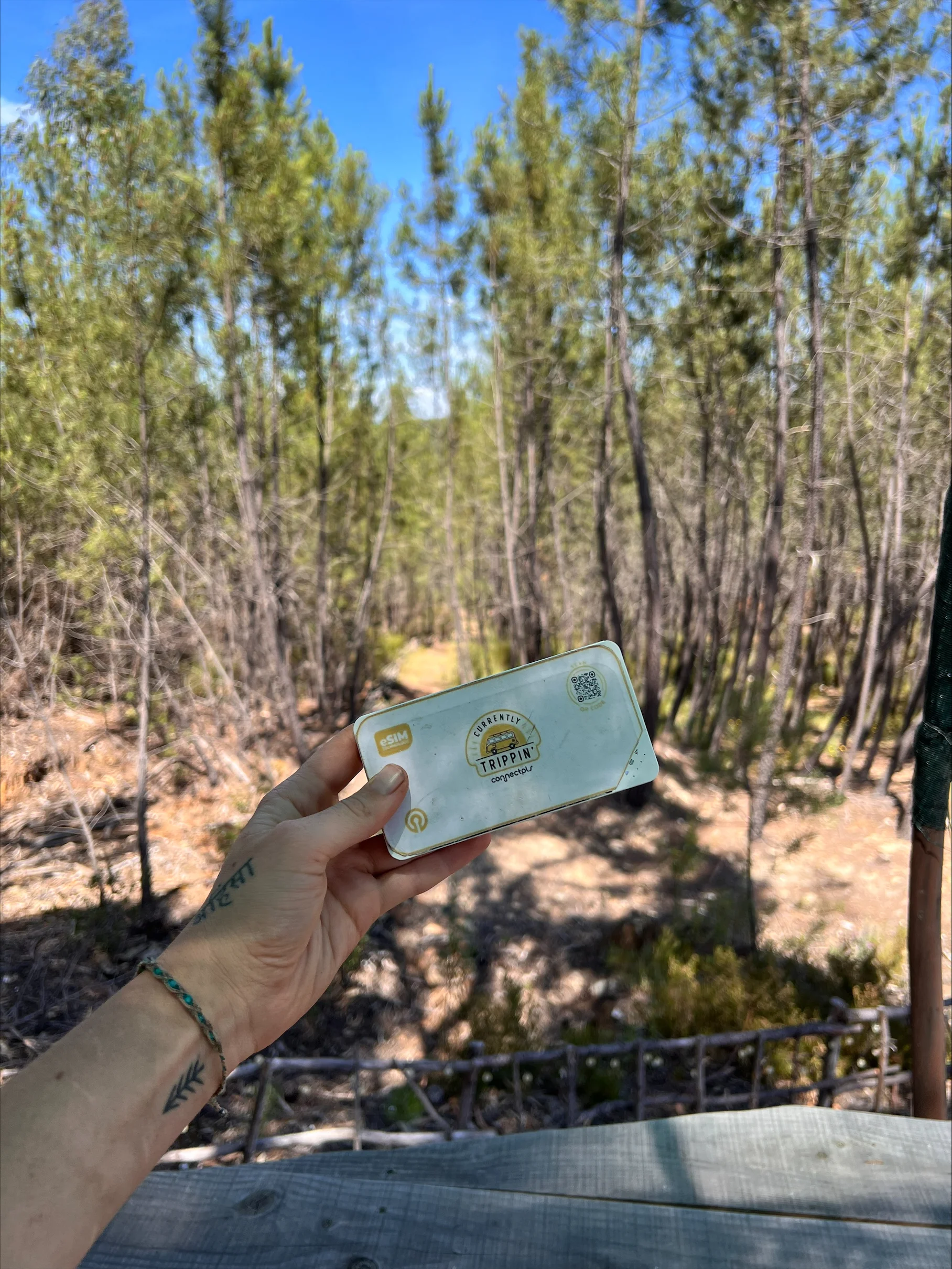
A portable WiFi router is a small device (roughly the size of a phone) with its own SIM or cloud-SIM technology that creates a private WiFi network. You connect your laptop, tablet, phones — up to 10 devices with most models — just like you would to WiFi at home. The router handles the cellular connection, you handle your work or navigation or streaming.
Modern routers use cloud-SIM technology, which means they can switch between multiple mobile operators automatically depending on signal strength and location. ConnectPls routers also include a backup physical SIM slot, so if you’re somewhere remote and want to pop in a local SIM for extra coverage, you can.
The key advantage for caravan travel: you turn it on in the UK, drive through France, camp in Spain, detour through Portugal, and the connection just works. No border admin, no SIM swaps, no figuring out which local carrier has the best coverage in rural Andalusia.
Real-World Capacity: What “Unlimited” Actually Means
This matters more than marketing claims. When we say the ConnectPls Plus Europe package is truly unlimited across 70+ countries, we mean it. No fair-usage throttling, no “unlimited until 20GB then we slow you down” clauses. That includes the UK, Ireland, France, Germany, Spain, Italy, Portugal, Netherlands, all the Nordics, Turkey, and extends to Canada, Mexico, Australia, and New Zealand.
If you’re van-lifing primarily across Western and Northern Europe, you can run video calls, upload photos, stream in the evenings, and navigate all day without watching a data meter. That’s the kind of setup that works when connectivity is your office, not just a convenience.
For countries like Japan, China, Thailand, or the UAE, the connection is 4G unlimited but may slow after roughly 5GB in a day (which is still more than most people use). For more remote destinations like Morocco or Egypt, you get 500MB per day at full 4G speed, then it drops to 256kbps. Enough for messaging and maps, not for Zoom.
Subscription vs Rental: Which Model Fits Continuous Van Life
Most guides will point you toward short-term rental services. Rent a pocket WiFi device for £8-12 per day, return it when you’re done. That makes sense if you’re flying to Japan for two weeks or doing a one-off summer road trip.
It falls apart for the way most van lifers actually travel: a few months in Europe, back to the UK for a bit, then off again. Or continuous travel with varying intensity. Rental services charge daily, so a three-month trip costs £720-1080. And you’re constantly organizing pickups, returns, and deposits.
The subscription model works differently. With ConnectPls, the mobile router device is included in your monthly plan. We ship it to you (2-3 working days across Europe, 4-5 days in the UK), you activate it for the months you’re traveling, and pause when you’re not. No daily fees stacking up, no hardware deposits, no return deadlines. You’re billed monthly, cancel anytime, and the flexibility matches how van life actually works.
There is a £25 early cancellation fee if you cancel a mobile-router subscription within the first three months, which covers the shipping and logistics of getting the device to you and back. Beyond that, you’re not locked into annual contracts or committed to paying for months you’re parked at home.
Delivery Reality: Getting Set Up Before You Roll
One of the pain points we hear about constantly: “I arrive in Spain and then have to figure out where to pick up my rental router.” With a subscription service, you get the device shipped to your home address before you leave. It’s ready to go the moment you cross the channel or land at your first stop. For most EU and UK addresses, shipping is included.
That front-loaded simplicity matters when you’re coordinating van maintenance, route planning, and packing. One less thing to figure out on arrival.
What About Campsite WiFi and Phone Tethering?
Campsite WiFi ranges from “surprisingly decent” to “technically exists but unusable.” Even the good ones are shared across dozens of pitches, so evenings and weekends slow to a crawl. Fine for checking email, terrible for video calls or uploading a day’s worth of photos.
Phone tethering (hotspot mode) works as a backup, but as your primary connection it’s a battery killer and often limited by your phone plan’s terms. Most UK and EU carriers allow some roaming, but tethering abroad either isn’t included or eats through your allowance fast. And it still doesn’t solve the border-crossing problem if you’re moving between countries frequently.
A dedicated router gives you consistent, predictable connectivity that doesn’t depend on where you park or drain your phone by lunchtime.
Costs for Long-Term Motorhome Travel Across Europe
Let’s be honest about what things actually cost. Renting portable WiFi daily runs £8-12/day depending on the country and provider. A month of that is £240-360. Local SIM cards in France, Spain, or Portugal typically cost €20-40/month for decent data, but you’re buying a new one at every border and dealing with local paperwork, sometimes requiring a local address or ID.
Subscription portable WiFi sits in the middle for monthly cost, but removes the border friction and hardware juggling. You’re paying for the simplicity of one bill, one device, continuous coverage across the countries you’re actually visiting.
If you’re spending six months across France, Spain, and Portugal, the subscription model costs less than serial rentals and far less than home-carrier roaming. If you’re doing two weeks in Spain once a year, a short-term rental or a hefty local SIM will likely be cheaper.
Frequently Asked Questions
Can I use a caravan WiFi router while driving?
Yes, portable WiFi routers work while moving. They’re connecting to cell towers just like your phone does. Your passenger can navigate, answer emails, or keep kids entertained on long drives. Just make sure the router is charged or plugged into a USB port. Battery life on most modern routers is 8-12 hours of active use.
What happens if I’m in a remote area with weak signal?
Cloud-SIM routers automatically switch between available operators to find the strongest signal, which helps in rural areas where one carrier might have better coverage than another. That said, if you’re parked in a mountain valley with no cell service at all, no WiFi solution will work. You’d need satellite internet, which is a different setup entirely. The backup physical SIM slot lets you pop in a local SIM if you know a specific carrier has better rural coverage in that region.
Do I need a different router for travel outside Europe?
Not if your router has global coverage built in. ConnectPls routers work across 160+ countries with the same device, so if you’re van-lifing in Europe most of the year but drive to Turkey or fly the van to Morocco, you’re already covered. The data allowances and speeds vary by region (unlimited in Group 0 countries, capped daily limits in others), but the hardware is the same. No need to buy or rent a second device for different continents.
Stay connected from the moment you land
ConnectPls provides eSIM plans, SIM cards, and portable WiFi subscriptions for van lifers across 200+ countries — activated before you fly, working the moment you land, at local rates with flexible monthly billing and no surprise bills.