
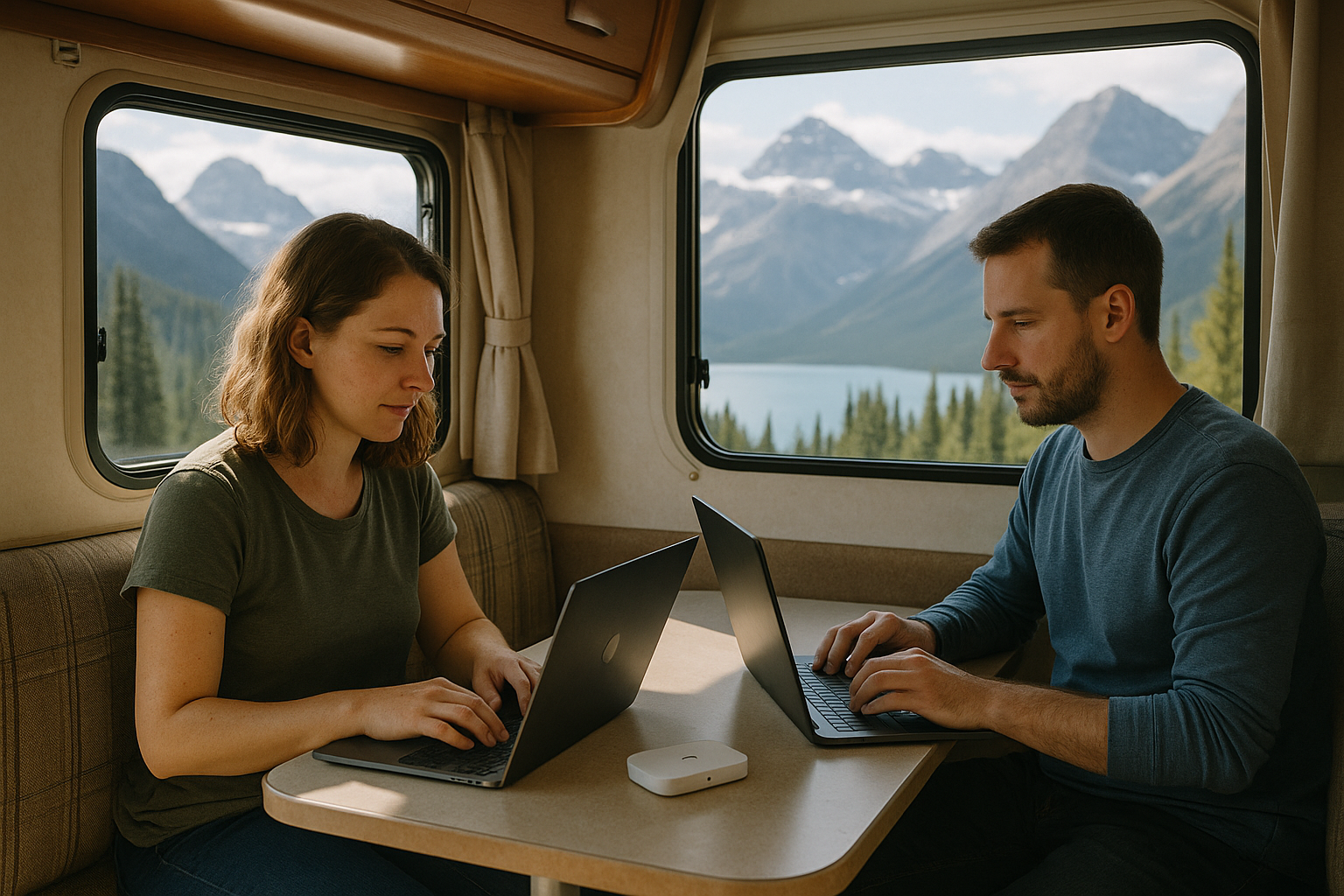
If you’re driving a motorhome or van between the US and Canada—maybe you’re wintering in Arizona then heading to the Canadian Rockies for summer, or doing the Alaska Highway—you already know the connectivity headache. Cross that border and your phone plan either stops working or starts bleeding roaming charges. Campground WiFi is a lottery. Buying a local SIM in each country means swapping cards, losing your number, and explaining to family why you’re unreachable for two days.
Portable WiFi subscriptions built for cross-border travel solve this properly. Not the airport rental kiosks or pay-per-day devices—those add up fast on a month-long trip. We’re talking about monthly plans that work the moment you land in either country, cover multiple devices at once, and bill predictably without contracts. This guide walks through what actually works when you’re crossing the 49th parallel regularly.
Why USA-Canada Travel Breaks Most Connectivity Solutions
The US and Canada look like a single connectivity market on a map. They’re not. Most US carriers treat Canada as international roaming (expensive). Canadian carriers do the same in reverse. Tourists grabbing a short-term SIM at arrival work fine for a week in one country, but cross the border and you’re buying another SIM, transferring contacts, and reconfiguring everything.
eSIM plans marketed as “North America” often mean Mexico-US or just lower-48 states. Read the fine print and Canada may be excluded or capped at 1GB. For van lifers who work remotely, stream navigation, upload photos, and video-call home, those limits vanish in days.
Home-carrier roaming plans? We support travelers every day who thought their “international plan” covered them, then got $400 bills after two weeks in the Yukon. The surprise isn’t malicious—it’s that “unlimited” at home becomes “pay-per-MB” abroad, and nobody reads the 47-page roaming PDF.
“So many countries we visited over the last 2 months, from Ireland to Turkey and back home again, and they were always there for us 24/7. Truly a pleasure — 150% satisfaction.”
— Sergey Kondratiev, verified ConnectPls customer
What Makes Portable WiFi Better for Border-Crossing Trips
A portable WiFi device (often called a mobile hotspot or pocket WiFi) is a battery-powered router that creates a private WiFi network. You connect your phone, laptop, tablet, and partner’s devices to it—up to 10 at once—and the router handles the cellular connection. For cross-border motorhome travel, three things matter:
One Device, Both Countries, No SIM Swaps
Cloud SIM technology (what ConnectPls uses) automatically switches between local operators in each country. Drive from Washington State to British Columbia and the router picks up a Canadian network without you touching it. No SIM cards to pop out, no roaming add-ons to buy, no explaining to a shopkeeper in Vernon that you need a data-only plan for 11 days.
The ConnectPls Plus Europe subscription includes truly unlimited data across 70+ countries, and yes, that list includes both Canada and the US in “Group 0.” That’s not “unlimited-with-asterisks.” It’s the same full-speed LTE we use for travelers doing three-month campervanning loops through France and Spain, now covering North America the same way.
Multiple Devices Without Per-Device Fees
In a motorhome, connectivity isn’t just your phone. It’s your partner’s laptop on a work call, your tablet running navigation, a smart TV streaming in the evening, maybe a kid’s device. Buying eSIMs or SIM cards for each one gets expensive and complicated. A portable WiFi hotspot connects all of them to one data plan, one bill.
We ship travelers a mobile router that’s included in the monthly subscription—you don’t buy hardware upfront. Activate it for the months you’re traveling, pause billing when you’re home for winter. It arrives within 4-5 working days in the UK or 2-3 across Europe, so you’re not scrambling at the airport.
Predictable Monthly Billing That Pauses When You Do
Van life isn’t 365 days a year for most people. You travel May through September, then park up. Rental pocket WiFi charges per day, and $8-12 adds up to $360 for a 30-day trip. You pay that every trip. Home-carrier day passes (like $10/day roaming) cost $600 for a two-month summer adventure.
ConnectPls bills monthly. Travel for three months? Pay three months. Home for six? Pause it—no fee to restart (only a £25 early cancellation fee if you quit a mobile-router plan in the first 3 months, covering our shipping and return cost). No contracts, cancel anytime. We’ve had customers doing annual Alaska-to-Mexico routes who activate April, pause November, restart the same account next spring.
How This Compares to Other Options for US-Canada Trips
| Solution | Pros | Cons | Best For |
|---|---|---|---|
| Home Carrier Roaming | Keep your number, no setup | Expensive ($10+/day or high per-MB fees), surprise bills, often capped data | 3-4 day business trips where convenience beats cost |
| Local SIM in Each Country | Cheap if staying put, local rates | Swap SIMs at border, lose number, single device only, staff may not speak English | Month-long stay in one country, comfortable with tech setup |
| North America eSIM | No physical card, easy activation | Most cap Canada heavily or exclude it, per-device cost, phone-only | Smartphone-only travelers on short US trips (not motorhomes) |
| Portable WiFi Subscription | True unlimited in both countries, all devices covered, monthly flexibility, no border hassle | Requires carrying device (though it fits in a pocket), upfront monthly cost | Motorhome/van trips crossing borders, remote workers, families with multiple devices |
Real Scenarios Where This Works (From Our Support Desk)
We hear from customers doing versions of the same trip: retired couples in a campervan touring national parks from Banff to Yellowstone over 10 weeks. Remote workers escaping UK winter to spend January-March in California, then April-May in Vancouver Island. Families doing the Alaska Highway who need WiFi for kids in the back and navigation up front.
One customer last summer drove Vancouver to Anchorage and used the hotspot for work calls parked in Yukon campgrounds. Our 24/7 support helped him troubleshoot signal in remote spots. He continued into Alaska where the Group 0 unlimited data kept working without him doing anything. Total cost: three months’ subscription. A rental device at $10/day would’ve been $900.
Another scenario: the “snowbird” pattern. Park your RV in Arizona November-March, drive back to Ontario for summer. Activate the WiFi subscription October, pause it April. That’s six months billed, six months not—same device, same account, nothing to return or reorder.
What About Other Countries? (Europe, Australia, Japan)
If your travel isn’t just US-Canada—maybe you’re doing motorhome broadband for France and Spain one year, then North America the next—the same ConnectPls subscription covers 160+ countries. That Plus Europe package with unlimited data includes 70+ “Group 0” countries: all of Western Europe, the Nordics, UK, Ireland, Turkey, Canada, US, Mexico, Australia, and New Zealand.
Heading to Japan? That’s “Group 1″—still unlimited data but may slow after roughly 5GB/day (which is a lot; most travelers don’t hit it). Planning Morocco or Brazil? That’s “Group 2” with 500MB/day at full speed, then 256kbps. The point is one device, one subscription, and you’re not researching “renting pocket WiFi in Japan” or “cheapest pocket WiFi Australia” every trip because you already have it.
Van lifers doing multi-continent routes—three months in Europe, three in North America—just leave the subscription active or pause between legs. The cloud SIM inside switches networks automatically when you land.
The Real Costs (And When It’s Not Worth It)
ConnectPls monthly plans bill per month active. That’s cheaper than daily rentals on any trip longer than a week, but more than a single local SIM if you’re staying in one US state for a month and never crossing the border. Be honest about your travel pattern:
- Worth it: Multi-week cross-border trips, multiple devices (motorhomes, families), repeat travel (annual summer routes), remote work needing reliable connectivity.
- Not worth it: A single 4-day city break where you’ll use hotel WiFi, or a month-long stay in one Canadian city where a local prepaid SIM is $40 and covers you fine.
We’ve written honestly about how much portable WiFi costs elsewhere. The real expense is opportunity cost. Pay $12/day for rental WiFi on a 60-day trip and you’ve spent $720. Pay monthly for a subscription and it’s a fraction, plus you keep the device for next year.
How to Get Started Before You Cross the Border
Order the portable WiFi subscription before you fly or drive out. It ships in 4-5 working days to UK addresses, 2-3 across Europe (US shipping included for most addresses—confirm at checkout). It arrives with the device, charging cable, and instructions. Turn it on when you land or cross the border; it picks up a local network within seconds.
You’ll get a backup physical SIM slot too, useful if you’re in a remote area and want to pop in a local SIM for extra redundancy. The cloud SIM usually handles it, though. Connect up to 10 devices via WiFi (secured with a password you set). Battery lasts a full day of moderate use; charge it in your vehicle or via USB power bank overnight.
Support is 24/7 if something feels off. Our Google reviews mention people getting help at odd hours from Patagonia campgrounds and Norwegian fjords—van lifers don’t keep office hours. No phone menus, no outsourced scripts. You’re talking to the team that packed your device.
Frequently Asked Questions
Does portable WiFi work in rural areas between cities in the US and Canada?
Coverage follows local cellular networks. In the US and Canada, that’s generally strong along highways and in national parks near roads, weaker in true backcountry (same as your phone). The cloud SIM switches between multiple operators, which often gives better coverage than being locked to one carrier. We’ve had customers report signal in Yukon campgrounds and along the Alaska Highway where their UK phone had nothing, because the router picked up a local carrier their phone couldn’t access.
Can I use this for work video calls while traveling?
Yes. Group 0 unlimited data (which includes US and Canada in the ConnectPls Plus Europe plan) has no daily throttling or fair-use cap. Customers do full-day Zoom calls from campsites. Latency depends on the local 4G network—usually fine for calls, occasionally slower in remote spots, same as any mobile connection. If you’re uploading gigabyte video files daily, test in the first few days to confirm local signal is strong enough for your workflow.
What happens if I drive into Mexico from the US?
Mexico is also Group 0 on the Plus Europe plan, so it just keeps working. Drive from California into Baja and the router switches to a Mexican network automatically. Same unlimited data, no action required. That’s the practical benefit of the “Group 0” country list—it’s not just Europe or just North America; it’s 70+ countries where you genuinely forget about connectivity and just use it.
Stay connected from the moment you land
ConnectPls provides eSIM plans, SIM cards, and portable WiFi subscriptions for motorhome and van travelers across 200+ countries — activated before you fly, working the moment you land, at local rates with flexible monthly billing and no surprise bills.