
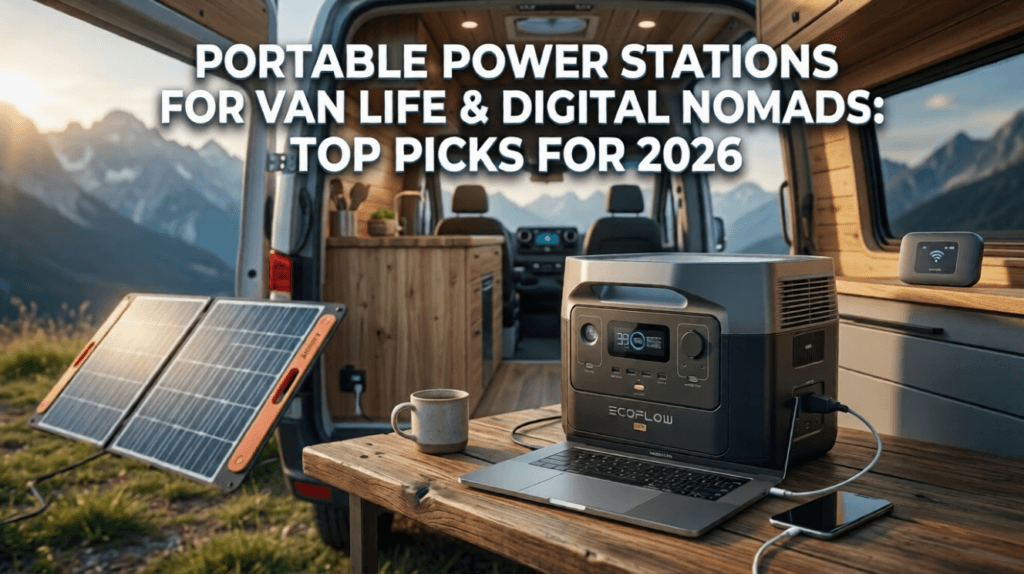
Portable Power Stations for Van Lifers and Digital Nomads: Top Picks for 2026
There’s a specific kind of panic that hits every van lifer and digital nomad eventually: you’re parked at a stunning spot in the middle of nowhere, the view is incredible, the WiFi hotspot is working and then your laptop hits 8%.
For anyone who works on the road, power is the resource that quietly controls everything. It decides where you can park for the night, how long you can work in a coffee shop parking lot, whether your router keeps running during a 6 hour mountain drive, and whether you wake up at 3am to plug your drone battery in before tomorrow’s shoot.
Portable power stations have evolved dramatically over the past few years. What used to be heavy, expensive, and unpredictable has become genuinely impressive technology lightweight LiFePO4 batteries, fast solar charging, app-controlled outputs, and enough capacity to run a full laptop setup for days without a wall socket.
This guide covers the best portable power stations for van lifers and digital nomads in 2026, what to look for before you buy, how to pair them with solar panels, and honest answers to the questions people search most when they’re trying to figure out if off-grid power actually works for remote work.
What to Look for in a Portable Power Station
Not all power stations are built the same, and the spec sheets can be genuinely confusing if you don’t know what matters. Here’s what to actually pay attention to:
Battery capacity (Wh). Watt-hours tell you how much total energy the station holds. A 1,000Wh station can, in theory, run a 100W device for 10 hours. For a laptop that draws around 45–65W, a 500Wh station gives you roughly 7–9 hours of use before it needs recharging. If you’re also running lights, a router, a phone, and a camera battery.
Output wattage (W). This is the maximum power the station can deliver at any moment. A station with 1,000W output can run most appliances and devices simultaneously. If you want to run a coffee maker, electric kettle, or small induction plate, you’ll need at least 1,200W output. For pure digital nomad use (laptop, router, phone, monitor), 600W is generally plenty.
Battery chemistry. LiFePO4 (lithium iron phosphate) is the current gold standard for van life and nomad use. It’s safer, more stable at temperature extremes, and rated for 2,000–3,500 charge cycles; versus 300–500 cycles for older lithium-ion units. If you’re using a power station daily on the road, this difference is enormous.
Solar input compatibility. If you’re planning to charge via solar panels — which is the smartest setup for van lifers — check the maximum solar input wattage and the MPPT charge controller specs. A station that accepts 200W of solar input will recharge much faster in the field than one limited to 60W.
Weight and portability. Van lifers can accommodate heavier units. Nomads who fly, take trains, and stay in short-term rentals need something they can carry. The sweet spot for carry-friendly stations is under 5kg (11 lbs), though larger capacity units can reach 15–20kg. Know your use case before buying.
Recharge time. Some modern stations support fast AC charging that tops them up in under an hour. Others take 6–8 hours from wall power. For nomads who only occasionally have wall access, this matters significantly.
📶 Power your devices, then connect them — get unlimited data SIMs and eSIMs for van life and nomad travel at connectpls.com/unlimited-data-sim
Best Portable Power Stations for Van Lifers and Digital Nomads in 2026
1. EcoFlow Delta 2 — Best All-Rounder for Digital Nomads
Capacity: 1,024Wh | Output: 1,800W (2,700W surge) | Weight: 12kg | Battery: LiFePO4 (3,000+ cycles)
The EcoFlow Delta 2 has become the default recommendation for digital nomads who want serious power without serious bulk. It charges from 0–80% in under 50 minutes via AC — meaning if you have an hour at a cafe, hostel, or campsite with a power hookup, you leave with a nearly full station.
The 1,800W output handles almost everything a nomad would want to run: laptop, monitor, USB-C hub, phone, router, camera batteries, a small fan, and a LED lamp — all simultaneously. The LiFePO4 chemistry means the battery degrades slowly, making it a genuine long-term investment for full-time road life.
Solar charging accepts up to 500W input, so paired with two 200W panels it can fully recharge in 3–4 hours of direct sun. The EcoFlow app gives you real-time monitoring of inputs, outputs, and battery state from your phone — useful when you’re working and want to know if you need to be more conservative.
The main trade-off is weight. At 12kg, it’s a two-handed carry. Fine for a van where it lives in the same spot; less ideal if you’re moving between accommodation on foot. For flying nomads who want occasional off-grid power, look further down the list.
2. Jackery Explorer 1000 Pro — Best for Reliability and Solar Pairing
Capacity: 1,002Wh | Output: 1,000W (2,000W surge) | Weight: 11.5kg | Battery: Li-NMC (1,000 cycles)
Jackery is the brand that arguably made portable power stations mainstream, and the Explorer 1000 Pro remains one of the most trusted options on the road. It’s slightly less powerful than the Delta 2 in terms of output and cycle count, but what it lacks in peak specs it makes up for in a polished, reliable experience that van lifer communities have stress-tested for years.
The Jackery SolarSaga panels pair seamlessly with the Explorer range, and the combined Explorer 1000 Pro + 2x SolarSaga 200W bundle is one of the most popular off-grid setups for van build beginners. The all-in-one nature — one brand, one app, one support line — removes a lot of the compatibility guesswork.
The 1,000-cycle battery life is the one genuine downside for full-time van lifers. If you charge daily, that’s roughly 2.5–3 years before you notice significant capacity degradation. For seasonal or part-time van use, it’s practically a non-issue.
3. Bluetti AC200L — Best for High-Capacity Van Builds
Capacity: 2,048Wh (expandable to 8,192Wh) | Output: 2,400W | Weight: 28kg | Battery: LiFePO4 (3,500+ cycles)
If you’re building out a van to live in full-time and you want a power setup that can genuinely run a small apartment’s worth of devices — including a 12V compressor fridge, air circulation fan, full desk setup, and entertainment — the Bluetti AC200L is the station to look at.
The expandable capacity is a standout feature: you can attach additional Bluetti B300 battery packs to grow the total capacity up to 8,192Wh. That’s enough to run a full nomad setup for 3–5 days of heavy use without any sun input. Combined with a roof-mounted solar array (Bluetti accepts up to 900W of solar input on this unit), you get a nearly self-sufficient power system.
This is not a carry-it-to-a-cafe station. At 28kg, it lives in the van. But for anyone serious about full-time van life without hookups, it’s one of the most capable setups money can buy.
4. EcoFlow River 2 Pro — Best for Flying Nomads and Light Travellers
Capacity: 768Wh | Output: 800W (1,600W surge) | Weight: 7.8kg | Battery: LiFePO4 (3,000+ cycles)
For nomads who move between Airbnbs, boutique hotels, and short-term rentals but occasionally need off-grid power — a remote cabin, a rooftop workspace, a weekend camping trip — the River 2 Pro is the sweet spot between portability and real-world usefulness.
At 7.8kg, it’s heavy enough to feel premium but light enough that one person can carry it in a tote bag without drama. The 768Wh capacity handles a full work day for a laptop-and-peripherals setup, and the LiFePO4 battery means you’re not babying it.
Note: this is not a carry-on-friendly device. Airlines classify power stations as lithium batteries, and most carriers restrict them to 100Wh or less for cabin luggage (and prohibit them in checked bags). The River 2 Pro is for road travel — van, car, train, or bus — not for air travel.
5. Anker SOLIX C800 — Best Budget Option That Doesn’t Compromise
Capacity: 768Wh | Output: 800W | Weight: 10kg | Battery: LiFePO4 (3,000+ cycles)
Anker entered the power station market with the SOLIX range and immediately disrupted the mid-range. The C800 offers LiFePO4 chemistry, solid solar input, and a clean app experience at a price point that undercuts EcoFlow and Jackery by a meaningful margin.
It’s not quite as fast to charge as the Delta 2, and the output wattage is lower than the Explorer 1000 Pro — but for a nomad whose daily power needs revolve around a laptop, phone, router, and USB accessories, it covers everything comfortably.
The Anker SOLIX range is also backed by Anker’s reputation for reliable consumer electronics and solid customer support — something that matters when you’re dependent on a piece of kit and living three time zones from the nearest service centre.
Quick Comparison: Top Power Stations at a Glance
| Station | Capacity | Output | Weight | Battery | Best For |
| EcoFlow Delta 2 | 1,024Wh | 1,800W | 12kg | LiFePO4 | All-round nomad use |
| Jackery Explorer 1000 Pro | 1,002Wh | 1,000W | 11.5kg | Li-NMC | Solar pairing |
| Bluetti AC200L | 2,048Wh+ | 2,400W | 28kg | LiFePO4 | Full-time van builds |
| EcoFlow River 2 Pro | 768Wh | 800W | 7.8kg | LiFePO4 | Light travellers |
| Anker SOLIX C800 | 768Wh | 800W | 10kg | LiFePO4 | Budget-conscious |
🚐 Power covered — now sort your connection. ConnectPls portable WiFi keeps van lifers and nomads online anywhere in Europe and beyond: connectpls.com
Solar Charging for Van Lifers: What You Need to Know
A portable power station without solar panels is only half the equation for serious off-grid living. Here’s how to think about building a solar charging setup that actually keeps up with your power demands:
Match your solar input to your daily consumption. Start by calculating your daily Wh usage: add up the wattage of every device you use and multiply by the hours per day. A typical nomad work setup (laptop, router, phone, accessories) uses roughly 150–250Wh per day. A 200W solar panel in good sun generates around 600–900Wh per day. That’s a comfortable surplus for power maintenance.
Go for rigid panels over flexible where possible. Flexible panels are tempting for van roof installations because they’re lighter and lower profile, but they degrade faster and tend to overheat on dark roofs. Rigid monocrystalline panels are more efficient, more durable, and generate more power per square metre.
Angle and positioning matter more than panel count. A single 200W panel aimed directly at the sun outperforms two 100W panels at a poor angle. If your van roof is flat and you’re parked in direct sun, great. If you’re parked in shade or at a steep latitude in winter, consider a portable folding panel you can angle independently.
Check MPPT compatibility. All the power stations recommended above use MPPT (Maximum Power Point Tracking) controllers, which squeeze the most energy out of variable solar conditions. Make sure your panels’ open circuit voltage (Voc) falls within the station’s accepted input range — connecting an incompatible panel can damage the charge controller.
Power Station Tips for Remote Workers Specifically
Power stations aren’t just about keeping your laptop alive. For nomads who rely on connectivity, here’s how power management integrates with your work setup:
- Prioritise your router. Your internet connection (portable WiFi hotspot, router, or eSIM device) uses very little power — usually 5–15W — but it runs continuously. Make sure it’s on a circuit that won’t cut out if you accidentally overload a USB port.
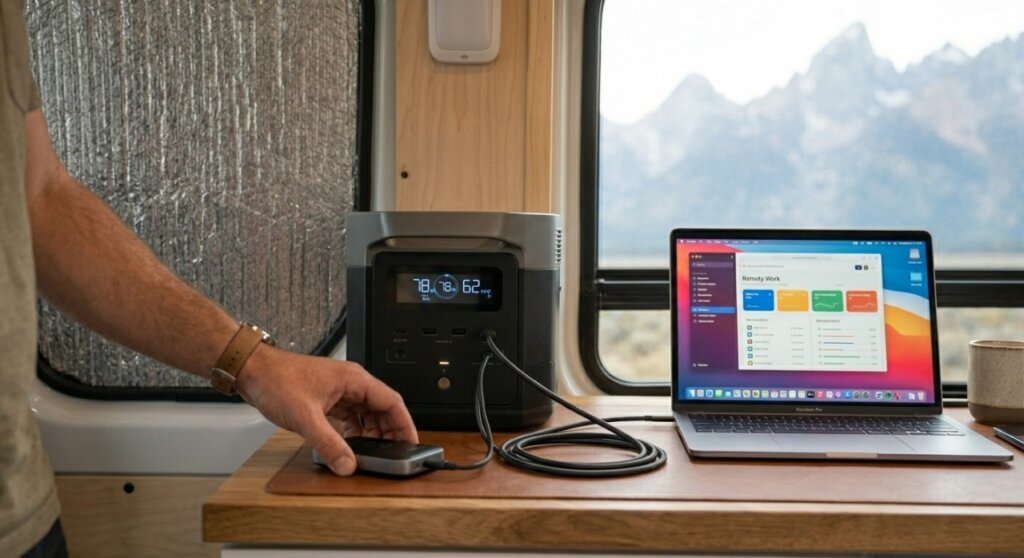
- Use USB-C PD for laptop charging. Charging your laptop via USB-C Power Delivery (PD) uses less energy than running it through an AC inverter. All the stations above support 100W USB-C PD output, which handles modern MacBooks and most Windows ultrabooks directly.
- Don’t drain to zero. Even LiFePO4 batteries benefit from staying between 20% and 90% for daily cycling. Most power station apps let you set a charging ceiling — use it to extend battery life over the long run.
- Know your station’s idle draw. Some stations draw 5–15W just being switched on, even with nothing plugged in. If you go to sleep with the station on but nothing running, that idle draw can add up overnight. Switch off outputs when not in use.
- Temperature matters. LiFePO4 batteries perform best between 0°C and 45°C. In very cold van winters (below -10°C), capacity drops noticeably and charging slows. Some stations have internal heaters to address this. If you’re winter vanning in Scandinavia or the Alps, check the cold-weather specs.
Frequently Asked Questions
Can I use a portable power station to run a laptop all day?
Yes, comfortably. A modern laptop draws between 30W and 65W under typical use (higher under heavy load). A 500Wh power station gives you roughly 8–12 hours of laptop use on a single charge, depending on the model. A 1,000Wh unit easily covers a full work day for a laptop, router, phone, and accessories with capacity to spare.
Are portable power stations allowed on aeroplanes?
This is one of the most commonly misunderstood rules in travel. Most portable power stations are not allowed on commercial flights — either in cabin baggage or checked luggage — because they exceed the airline limit of 100Wh for lithium batteries (most stations are 500Wh and above). A small exception: batteries under 100Wh can go in carry-on with no approval, and 100–160Wh with airline approval. If air travel is part of your nomad life, a portable power station is a ground-travel tool, not an aviation-travel tool.
How long does it take to charge a portable power station from solar?
It depends on the station’s solar input rating and the panel wattage. A 1,000Wh station accepting 200W of solar input takes roughly 5–6 hours in optimal direct sunlight to fully charge. Real-world conditions (clouds, angle, dust on panels) typically add 30–50% to that estimate. A 400W solar input cuts that to 2.5–3 hours in good conditions — which is why matching a higher-wattage panel array to a quality station makes a significant practical difference.
What’s the difference between a portable power station and a generator?
A petrol or diesel generator produces power by burning fuel — it’s loud, produces exhaust fumes, requires fuel storage, and can’t be used in enclosed spaces or many campsites. A portable power station is a large rechargeable battery that stores power silently, produces zero emissions at point of use, and can be charged from solar, a wall outlet, or a vehicle. For van life and nomad use, a power station is almost always the better choice unless your power demands are very high (above 2,000Wh per day) and you have reliable fuel access.
Can I charge a portable power station while driving?
Yes — most portable power stations include a 12V car charging cable (also called a cigarette lighter input or car outlet cable). Charging via a 12V car socket is slow (typically 60–120W input, meaning 8–15 hours for a 1,000Wh unit), but if you’re driving 2–4 hours per day it adds a meaningful top-up. Some van builds wire the power station to the vehicle’s alternator directly via a DC-to-DC charger, which is faster and more efficient.
Which portable power station is best for a first-time van lifer?
The EcoFlow Delta 2 is the most commonly recommended starting point for first-time van lifers who work remotely. It balances capacity (1,024Wh), output (1,800W), charge speed, LiFePO4 longevity, and app connectivity in a package that covers the vast majority of digital nomad power needs. Pair it with one or two 200W solar panels and you have a complete off-grid power system that requires minimal technical knowledge to run.
Do portable power stations work in cold weather?
LiFePO4 batteries are more cold-tolerant than standard lithium-ion, but all battery chemistry slows in the cold. Expect 10–20% capacity reduction at 0°C and more significant drops below -10°C. Some premium stations (EcoFlow in particular) include a self-heating battery mode that warms the cells before charging in cold conditions. If you’re winter van camping in cold climates, check whether your chosen station supports cold-weather charging and consider insulating it overnight.
✈️ You’ve got your power sorted — now get your connectivity sorted. Browse ConnectPls eSIM plans for van lifers and remote workers: connectpls.com/esim
The Bottom Line
The best portable power station for you depends on one question above everything else: how do you actually travel? If you live in a van full-time and rarely fly, invest in the EcoFlow Delta 2 or Bluetti AC200L and pair it with proper solar input — you’ll rarely think about power again. If you’re a mixed-mode nomad who drives sometimes and flies sometimes, the River 2 Pro gives you real off-grid capability without the weight commitment.
What’s changed most in 2026 is that you no longer have to make significant compromises. LiFePO4 chemistry has democratised long-cycle batteries at reasonable prices, fast charging has made wall-top-up practical even on short stops, and MPPT solar charging means that a modest panel setup actually keeps pace with modern work demands.
Sort the power. Sort the connection. Everything else falls into place.