
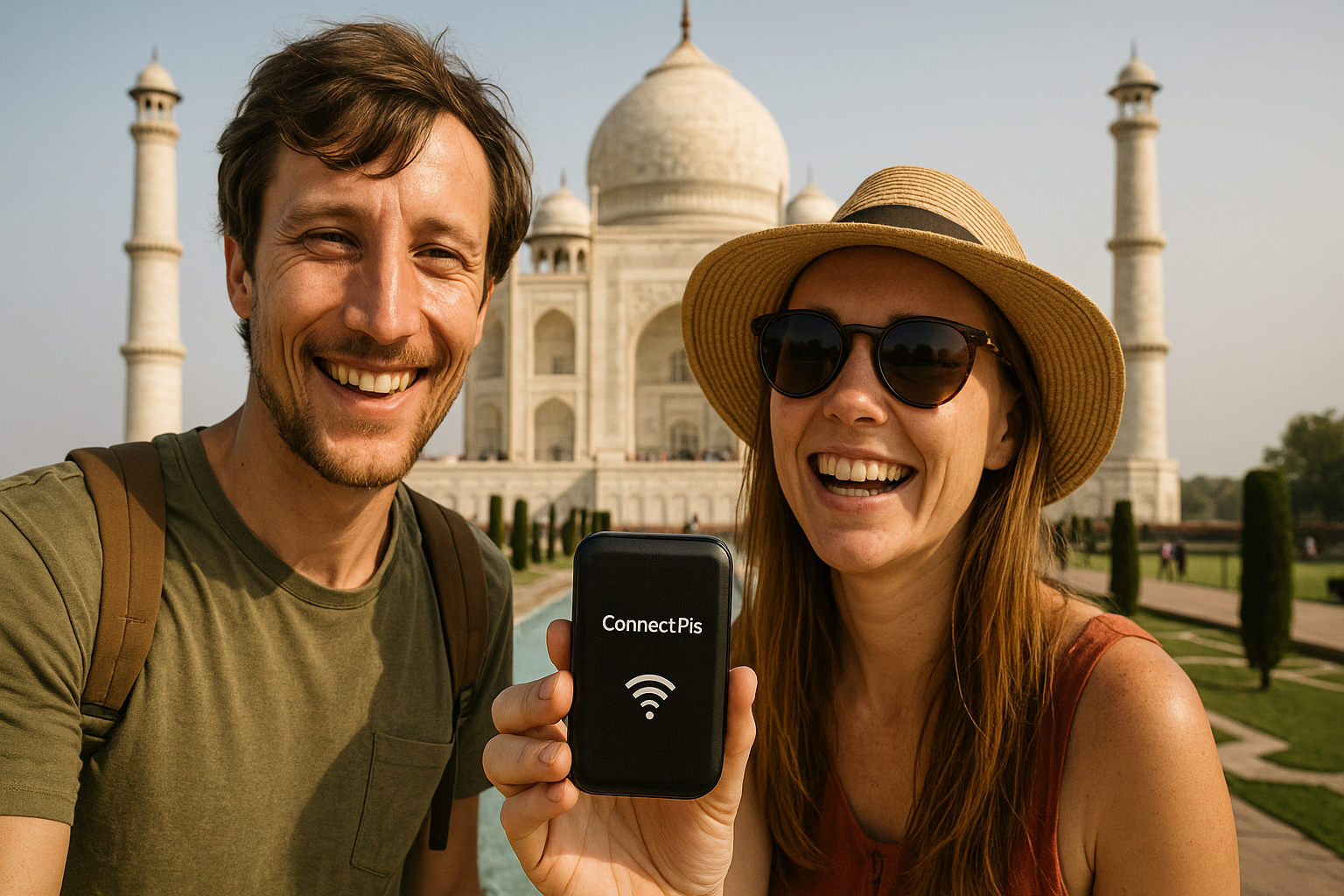
India has become a magnet for digital nomads in 2025. Goa’s coworking cafés, Dharamshala’s mountain quiet, and Bangalore’s tech hubs all offer month-long stays under €1,000 — accommodation, food, and transport included. But the country that perfected jugaad (improvisation) can still surprise you with patchy 4G, sudden SIM registration headaches, and hotel WiFi that cuts out mid-client call.
This guide is written for remote workers and digital nomads planning 30+ days in India — not two-week tourist trips. We’re the ConnectPls team: we’ve shipped portable WiFi devices to campervans crossing Europe, Erasmus students in Lisbon, and freelancers working winters in Kerala. We know what breaks (and what doesn’t) when you’re trying to hit a deadline from a beach shack in Arambol.
Visa and Entry: e-Visa Finally Reliable
India’s e-Visa system stabilised post-pandemic. Most passport holders get a 60-day tourist e-Visa online within 3-5 business days (£20-25). Apply at least two weeks before departure — server glitches still happen, and the embassy queue in London or Dublin is slow.
For stays beyond two months, look at the 365-day e-Visa for tourists (multiple entry, max 90 days per visit). True digital nomads often do “visa runs” to Nepal or Sri Lanka every 60-90 days. Kathmandu is a two-hour flight from Delhi, Colombo three hours from Chennai.
Important: India still has no official digital nomad visa. You’re technically on a tourist visa. Don’t mention “remote work” at immigration — “travelling and sightseeing” is safer.
“So many countries we visited over the last 2 months, from Ireland to Turkey and back home again, and they were always there for us 24/7. Truly a pleasure — 150% satisfaction.”
— Sergey Kondratiev, verified ConnectPls customer
Budget Reality: What £800/Month Actually Buys
India’s cost-of-living advantage is real, but 2025 prices in nomad hubs have crept up. A realistic monthly budget for comfortable (not backpacker) life:
- Goa or Rishikesh: £400-600 for a one-bedroom flat with AC and decent WiFi (negotiate monthly rates directly with landlords, not Airbnb)
- Food: £150-200 if you mix street food (₹60 thalis) with expat-friendly cafés (₹400 avocado toast)
- Coworking/cafés: £50-100 (many buy a coffee and camp all day; monthly coworking passes run ₹5,000-8,000)
- Transport: £30-50 (auto-rickshaws, occasional Ola/Uber, one domestic flight if you move cities)
- Connectivity: £20-40 depending on your setup (more on this below)
You can live on less in Varanasi or Mysore, but the coworking infrastructure is thinner. Bangalore or Mumbai will run you closer to £1,200/month.
Health and Safety Prep
Get hepatitis A, typhoid, and a tetanus booster before you fly. Rabies vaccination is worth it if you’ll be in rural areas or around street dogs (post-bite treatment in India is doable but stressful mid-deadline).
Pack a basic medical kit: oral rehydration salts, Imodium, antibiotic cream, and any prescription meds you need (including three months’ supply — Indian pharmacies are excellent but your specific brand may not exist). Drink only bottled or filtered water. Most nomads get mild food poisoning once in the first month; it passes.
Travel insurance that covers India is essential. Companies like SafetyWing or Genki work well for long-term travellers. Indian private hospitals (Apollo, Fortis) are world-class but expensive without cover.
Connectivity Options: What Works Beyond Week One
This is where most India guides get vague. Hotel WiFi and café promises rarely survive a video call. Here’s what we see work (and fail) for remote workers staying 30+ days:
Local SIM Cards: Cheap But Bureaucratic
Airtel and Jio offer prepaid plans with 2GB/day for ₹500-700/month (under £7). Coverage is solid in cities, patchy in Himachal hills. The catch: activation requires a local address, passport copies, and a photo. Some shops do it in 20 minutes; others ghost you for three days. Recharges (top-ups) happen via app or corner stores, easy once you’re set up.
If you’re in one city the whole month and comfortable with Indian paperwork, a local SIM is the cheapest data option. If you’re moving between Goa, Rajasthan, and Kerala every ten days, the activation hassle multiplies.
Home-Carrier Roaming: £8/Day Adds Up Fast
UK networks charge £5-8/day for India roaming (Vodafone, Three, EE all similar). That’s £150-240/month for data you’d pay £6 for locally. Fine for a long weekend; absurd for February in Goa.
Portable WiFi: Monthly Subscriptions vs Short Rentals
India sits in ConnectPls’s “Group 1” countries: 4G unlimited data on our mobile router, with speeds slowing after roughly 5GB per day. The device connects up to 10 laptops/phones at once, useful if you’re travelling with a partner or sharing a villa with other nomads.
We ship the router (hardware included in the plan, no upfront purchase) to your UK or EU address in 2-3 working days, so you activate it before you fly and it works the moment you land in Delhi or Mumbai. Coverage is automatic across multiple Indian operators via Cloud SIM, plus a backup physical SIM slot if you’re in a remote corner of Ladakh.
The honest trade-off: this makes sense for one-month-plus India trips, especially if you’re combining India with Thailand or Sri Lanka (same subscription covers 160+ countries). If you’re only in Mumbai for six days, a short-term pocket WiFi rental from a local Indian company will be cheaper, but those don’t ship internationally and quality is hit-or-miss.
Billing is monthly and flexible. You activate for January and February while you’re in India, pause in March when you’re back in Berlin. No long-term contract, no cancellation penalty after the first three months (there’s a £25 fee if you cancel a mobile-router plan earlier, covering the return shipping).
eSIM: If Your Phone Supports It
ConnectPls also offers eSIM plans (same Group 1 India coverage, same monthly billing). Works great if you’re travelling alone with a recent iPhone or Pixel and don’t need to connect a laptop separately. Less useful if you’re juggling multiple devices or your laptop doesn’t have an eSIM.
Comparison: One Month in Goa
| Option | Cost (30 days) | Setup Effort | Best For |
|---|---|---|---|
| Local SIM (Airtel/Jio) | ~£7 | Paperwork, local address, 1-3 days activation | Single-city stays, comfort with Indian admin |
| UK roaming (Three, Vodafone) | £150-240 | Zero — works on landing | Short trips only (3-5 days) |
| Portable WiFi subscription (ConnectPls) | Monthly plan (Group 1 India) | Ships to home address, activate before you fly | Multi-city travel, multiple devices, 30+ days |
| eSIM subscription | Monthly plan (Group 1 India) | Instant QR code, compatible phone needed | Solo travellers, phone-primary work |
Moving Around India: Trains, Flights, and Scooters
Book trains via the IRCTC app (India’s national rail site). Sleeper class is cheap (₹500 Delhi-Jaipur) but overnight AC 2-tier is more comfortable for long hauls (₹1,500-2,000). Tickets sell out weeks ahead during holidays (Diwali, Holi), so plan early.
Domestic flights (IndiGo, SpiceJet) often cost less than £30 if booked a month out. Delhi-Goa is two hours versus 30 hours by train. Budget airlines nickel-and-dime for bags and seat selection, but the time saved is worth it.
Renting a scooter in Goa or Rajasthan is common (₹300-500/day, ₹6,000-8,000/month). Indian traffic is chaotic. If you’ve never ridden in Asia, start with short trips. International Driving Permit (IDP) required legally, rarely checked, but essential for insurance claims.
Why Some Nomads Combine India with Thailand or Portugal
We see a pattern: digital nomads spend December-February in India (perfect weather in Goa, Rajasthan, Kerala), then March-May in Thailand or Bali to escape India’s brutal pre-monsoon heat. Or they reverse it: monsoon months (June-September) in Portugal or Spain, winter in India.
ConnectPls subscriptions cover this well. The same portable WiFi plan works across India, Thailand, Portugal, Spain, France, Germany, and 160+ other countries. You’re not buying a new device or SIM every time you cross a border. That device-included model means you’re not lugging separate rentals from five countries. One router, shipped to your home address before the trip starts, works everywhere.
What We’d Do Differently Next Time
After years shipping devices to travellers in India, here’s what we hear went wrong (so you don’t repeat it):
- Book accommodation with confirmed fibre WiFi and have a backup connectivity plan. “Good WiFi” in the listing photos means nothing.
- Arrive in India with connectivity already working. Scrambling for a SIM card at 11pm in Delhi airport when you have a morning call is miserable.
- Don’t underestimate the heat from March onward. Goa in April is 38°C with 80% humidity; you’ll want AC, which doubles electricity costs.
- Factor in “India days,” the days when nothing works (internet cuts, power outage, food poisoning) and you can’t be productive. Build buffer time into client deadlines.
Frequently Asked Questions
Can I work legally in India on a tourist e-Visa?
Officially, no — tourist visas don’t permit employment. In practice, thousands of digital nomads work remotely for non-Indian clients on tourist visas. Don’t mention “work” to immigration officers, don’t invoice Indian clients, and keep a low profile. India has no enforcement mechanism for foreign remote workers yet, but the legal grey area exists.
Is portable WiFi better than a local SIM for a two-month India trip?
If you’re moving cities every 7-10 days (Jaipur, Udaipur, Goa, Kerala), portable WiFi or eSIM saves you from reactivating SIMs in each state (yes, Indian SIMs sometimes stop working across state lines). If you’re planted in one city for eight weeks, a local Airtel SIM is cheaper. For trips mixing India with Nepal, Sri Lanka, or Thailand, a multi-country subscription (portable WiFi or eSIM) wins on convenience.
What’s the real WiFi situation in Goa coworking spaces?
Patchy. Spaces like Bhive or CoworkIn in Panjim have fibre and backup generators, but beach-town “coworking” cafés in Arambol or Palolem often run on the same flaky broadband as guesthouses. Always have a mobile hotspot (your phone + local SIM, or a portable WiFi device) as backup. We’ve had customers in Goa where the café WiFi died daily at 2pm and the portable router saved their client calls.
Stay connected from the moment you land
ConnectPls provides eSIM plans, SIM cards, and portable WiFi subscriptions for digital nomads across 200+ countries — activated before you fly, working the moment you land, at local rates with flexible monthly billing and no surprise bills.


