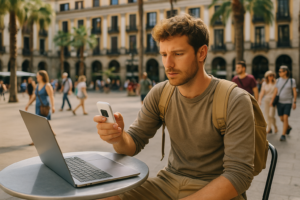

Chile stretches 4,300 kilometers from the Atacama Desert to the fjords of Patagonia, making it one of the world’s most geographically dramatic countries. For digital nomads considering a few months working from South America, Chile offers political stability, strong infrastructure in urban centers, and genuinely safe cities compared to many neighboring countries. But the same length that makes Chile fascinating also creates real connectivity challenges when you’re working remotely from wine valleys, national parks, or coastal towns.
I’m writing this from our experience supporting remote workers who’ve spent months in Chile. The question isn’t just which cities are safest—it’s how you maintain reliable internet when you’re 200 kilometers outside Santiago or working from a cabin near Torres del Paine. Chile’s safest cities are also its most connected, but the gaps between them matter more than most travel guides admit.
Santiago: Safety Meets Infrastructure
Santiago is Chile’s safest major city for digital nomads in 2025, particularly in neighborhoods like Providencia, Las Condes, and Vitacura. You’ll find coworking spaces, excellent cafés with reliable WiFi, and street crime rates comparable to many European capitals. The metro system is clean and safe until late evening.
That said, Santiago has pockets. Avoid walking alone at night in Estación Central or parts of downtown, and keep cameras hidden on public transport. The bigger issue for remote workers isn’t safety—it’s that Santiago’s café WiFi can be frustratingly inconsistent, especially during peak hours. Many digital nomads we’ve worked with ended up relying on personal hotspots rather than public networks for client calls.
“So many countries we visited over the last 2 months, from Ireland to Turkey and back home again, and they were always there for us 24/7. Truly a pleasure — 150% satisfaction.”
— Sergey Kondratiev, verified ConnectPls customer
Valparaíso: Bohemian and Increasingly Secure
Valparaíso had a rough reputation a decade ago, but focused policing in the Cerro Alegre and Cerro Concepción hills has made these artsy neighborhoods genuinely safe for travelers. Walking between the colorful houses and street art feels secure during daylight, and the creative community attracts long-term remote workers.
The trade-off: Valparaíso’s internet infrastructure hasn’t caught up with its tourism growth. Hostels and Airbnbs often share bandwidth across too many guests. If you’re planning video calls or uploading design files, test the connection before committing to a month-long rental. Having your own portable WiFi here isn’t optional—it’s the difference between meeting deadlines and apologizing to clients.
Puerto Varas and the Lake District: Small-Town Safety
Puerto Varas, near the stunning Osorno Volcano, offers what many digital nomads want: genuine safety (petty crime is rare), walkable streets, and a slower pace. The same applies to nearby Pucón, which combines outdoor adventure with a safe, tourist-friendly center.
These towns are ideal if you’re splitting time between work and hiking. The challenge is that outside the town centers, mobile coverage drops fast. We’ve had customers working from lakeside rentals who found their Chilean SIM card had zero signal. Chile’s geography—mountains, lakes, valleys—creates dead zones even a few kilometers from “connected” towns.
Why Connectivity in Chile Isn’t Just About Cities
Chile’s safest cities are also its most developed, which usually means decent internet until you leave the urban core. The country’s length and terrain mean that what works in Santiago (a local SIM card, maybe) becomes useless when you’re driving the Carretera Austral or staying in wine country near Colchagua.
This is where many digital nomads get tripped up. They buy a local SIM card in Santiago, it works great for two weeks, then they head south to work from Puerto Natales and discover their “unlimited” plan throttles video after 3GB or has no signal at their rental.
What Actually Works for Staying Connected Across Chile
From our experience shipping devices to remote workers in South America, here’s what holds up across Chilean cities and the gaps between them:
Local SIM Cards: Good in Cities, Patchy Elsewhere
Movistar, Entel, and WOM offer prepaid SIM cards you can buy at the Santiago airport. They work well in the capital, Valparaíso, and other major centers. The problem is twofold: coverage drops dramatically in rural areas and national parks, and you’ll need a local ID or passport to register the SIM (a process that can take hours at a retail store).
If your entire stay is urban and you’re comfortable managing top-ups in Spanish, a local SIM is cheap. If you’re moving around or working from anywhere outside the main cities, you’ll hit coverage gaps.
Home-Carrier Roaming: Expensive and Unreliable
Roaming on your UK, US, or European carrier in Chile typically costs £8-15 per day, and many plans don’t include Chile at all. Even when they do, you’re at the mercy of whichever local network your carrier has a roaming agreement with, often not the strongest one. For a month in Chile, you’re looking at £240+ in roaming fees, with no guarantee of reliable speeds outside Santiago.
Portable WiFi: The Multi-Device, Multi-Location Solution
This is where we see the biggest difference for digital nomads working across multiple Chilean cities and regions. A portable WiFi device with international coverage gives you consistent connectivity whether you’re in a Santiago coworking space, a Valparaíso café, or a rental near Vicente Pérez Rosales National Park.
ConnectPls ships a mobile hotspot to your address before you leave (2-3 days across Europe, 4-5 days in the UK), already activated and ready to work the moment you land in Santiago. Because it uses cloud SIM technology plus a backup physical SIM slot, it automatically connects to the strongest available network, switching between Movistar, Entel, or WOM depending on where you are.
Chile sits in our Group 2 coverage, which means 500MB per day at 4G speeds, then throttled to 256kbps. For many digital nomads, that daily allowance covers emails, messaging, light browsing, and occasional video calls, especially when supplemented by café or accommodation WiFi for heavy uploads. The device connects up to 10 devices at once, so your laptop, phone, and tablet all share the connection.
The monthly subscription model is what makes this practical for remote workers: you’re not locked into a yearlong contract or paying for connectivity during months you’re elsewhere. Activate it for your three months in Chile, pause it when you fly to Colombia or back home. No local paperwork, no foreign bank account, no surprise bills when you cross from one Chilean region to another.
Comparing Your Connectivity Options in Chile
| Option | Best For | Coverage in Chile | Setup Complexity |
|---|---|---|---|
| Local SIM Card | Budget travelers staying in major cities | Good in Santiago, Valparaíso; patchy in rural areas | Requires local ID registration, managing top-ups |
| Home-Carrier Roaming | Short business trips (3-5 days) | Depends on roaming agreement; often limited | Easy but expensive (£8-15/day) |
| eSIM | Single-device users (phone only) | Variable; typically Group 2 with daily caps | Quick setup but no multi-device sharing |
| Portable WiFi (ConnectPls) | Digital nomads, multi-device users, moving across regions | Nationwide via cloud SIM across operators | Shipped pre-activated; works on landing |
The Real Safety Question: Communication When It Matters
Chile’s safest cities are statistically secure, but the real safety net for any remote worker abroad is reliable communication. If you’re hiking in Pucón and twist an ankle, can you call for help? If your Airbnb in Valparaíso has a problem at 9 PM, can you message the host?
We’ve supported customers who spent months in Chile and consistently report that having their own portable WiFi gave them confidence to explore beyond the typical tourist circuits. One remote developer worked from a cabin outside Puerto Varas for six weeks, relying entirely on the hotspot because the rental’s advertised “WiFi” was a single-bar mobile signal that dropped during rain.
Chile rewards curiosity. The safest cities are wonderful, but the country’s real magic is in the spaces between them: the wine valleys, the lake crossings, the long drives through Patagonia. You can’t experience that properly if you’re tethered to Santiago’s city limits because you’re afraid of losing connectivity.
Frequently Asked Questions
Is Santiago safer than other South American capitals for digital nomads?
Yes, Santiago consistently ranks as one of the safest capitals in South America, with lower violent crime rates than Lima, Bogotá, or Buenos Aires. Petty theft (pickpocketing, bag snatching) exists, especially on the metro and in crowded areas, but violent crime targeting tourists is rare. Stick to well-traveled neighborhoods like Providencia and Las Condes, and you’ll find it comparable to many European cities.
Does portable WiFi work in Chilean national parks and rural areas?
It depends on the park. Torres del Paine, Vicente Pérez Rosales, and areas near Puerto Varas have patchy but usable mobile coverage where a portable WiFi device will connect when signal exists. Deep wilderness areas like parts of the Carretera Austral or remote Patagonian fjords have no coverage from any provider. A cloud-SIM device gives you the best chance because it switches between operators automatically, but it’s not magic. No device creates signal where none exists.
Can I use the same portable WiFi across Chile and other South American countries?
Yes, if your device has multi-country coverage like ConnectPls. Our mobile hotspot works across 160+ countries, including Chile, Argentina, Peru, Colombia, and Brazil, with the same monthly subscription. Chile and Brazil sit in Group 2 (500MB/day), while coverage and data allowances vary by country. This makes it practical for digital nomads doing a multi-country South America trip without swapping SIM cards at every border or managing multiple local plans.
Stay connected from the moment you land
ConnectPls provides eSIM plans, SIM cards, and portable WiFi subscriptions for digital nomads across 200+ countries — activated before you fly, working the moment you land, at local rates with flexible monthly billing and no surprise bills.